Survey conducted at EuroGames Lyon 2025 highlights the urgent need for action and the transformative role of inclusive sport
Across Europe, growing political attention is being paid to so-called conversion practices. Several countries have adopted bans, the European Parliament has repeatedly called for action, and the European Commission has recently announced new initiatives aimed at protecting LGBTQIA+ people from these harmful interventions.
Yet an important question remains: how widespread are conversion practices today, and what do they actually look like in the lives of LGBTQIA+ people?
A new report published as part of the Better in Colour, Better in Sports project offers important new insights.
Developed by Gaynet in partnership with EGLSF and ACT – Against Conversion Therapy, and implemented through Oxfam Italia's Connecting Spheres initiative funded by the European Union, the study presents the results of a survey involving 527 participants at EuroGames Lyon 2025, one of the largest LGBTQIA+ sporting events in Europe. The research was conducted under the scientific coordination of Professor Roberto Baiocco and Professor Jessica Pistella of Sapienza University of Rome.
While the survey is not statistically representative of the entire European LGBTQIA+ population, it provides one of the largest community-based datasets currently available on experiences related to discrimination, identity suppression and conversion efforts in a transnational LGBTQIA+ context.
Conversion practices are not a thing of the past
The findings challenge the widespread assumption that conversion practices belong to history.
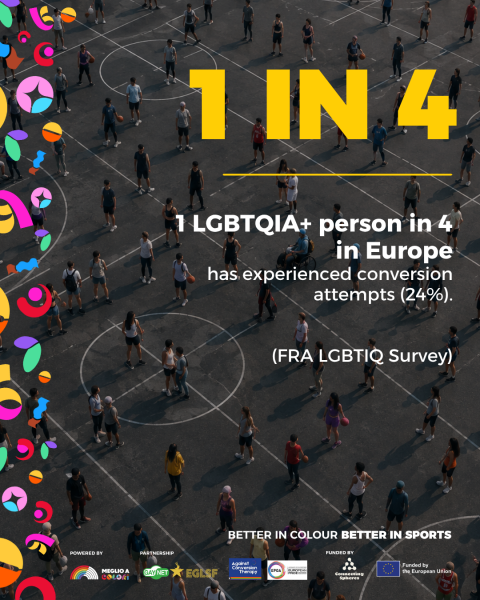
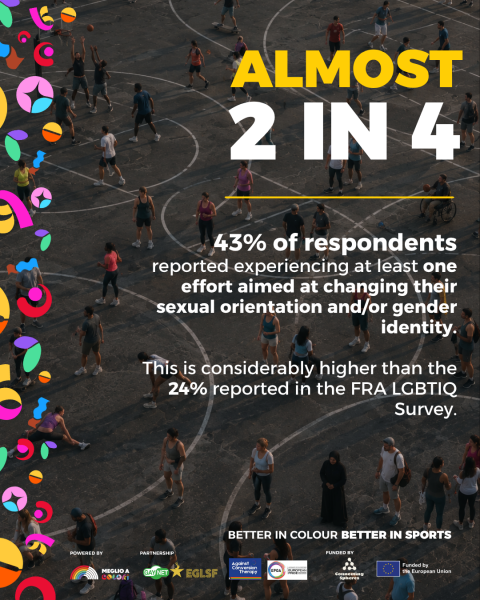
More than four in ten respondents (43.1%) reported having experienced at least one effort aimed at changing, suppressing or discouraging their sexual orientation, gender identity or gender expression. These experiences included family pressure, verbal humiliation, religious interventions, peer pressure, psychological treatment and even physical or sexual violence.
Perhaps even more telling is that after being provided with a clear definition of conversion practices, 15.7% of respondents reported knowing someone who had undergone them, while 3.8% reported direct personal experience and 11% said they were unsure whether what they had experienced should be considered conversion practices.
This uncertainty is significant.
Many conversion practices no longer appear as formal "therapies". Instead, they are experienced through repeated messages that a person should change, hide, suppress or correct who they are. The survey suggests that these pressures often operate in a grey area between discrimination, social control and explicit conversion efforts.
The family remains the primary arena
Contrary to the common perception that conversion practices are mainly linked to fringe religious groups, the survey identifies family environments as one of the most frequent sources of pressure.
Family members were the most commonly reported actors behind attempts to change LGBTQIA+ identities, often accompanied by religious authorities, mental health professionals, peers or wider social networks. In many cases, participants described overlapping forms of pressure coming simultaneously from several environments.
The consequences are profound.
More than 13% of respondents reported leaving home voluntarily because of discrimination linked to their LGBTQIA+ identity, while 3.4% reported being forced to leave.
These findings remind us that conversion practices are not only a legal or healthcare issue. They are also deeply connected to family acceptance, social inclusion and access to safe environments.
Discrimination remains widespread across Europe
The report also paints a broader picture of ongoing discrimination.
Nearly one-third of respondents (29.2%) experienced discrimination based on gender identity, gender expression or sex characteristics in the previous three years, while 41% experienced discrimination based on sexual orientation.
Participants reported experiences ranging from verbal harassment and exclusion to workplace discrimination, online hate speech, bullying, threats and physical violence.
The findings are a reminder that despite significant progress in many European countries, LGBTQIA+ equality remains fragile and unevenly distributed.
Those facing multiple forms of marginalisation are at greater risk
The survey confirms what many activists and researchers have long argued: vulnerability is shaped by intersectionality.
Trans and non-binary participants reported significantly higher exposure to conversion-practice experiences than cisgender LGB+ respondents. Likewise, participants who perceived themselves as belonging to an ethnic minority reported substantially higher levels of exposure.
These findings reinforce the need for policies that recognise the interaction between sexual orientation, gender identity, race, ethnicity and other dimensions of social inequality.
Sport can be part of the solution
The report was intentionally conducted during EuroGames because the project sought to investigate not only experiences of discrimination but also the potential of sport as a positive force for change.
The results are encouraging.
Most participants reported that sport helped them affirm their LGBTQIA+ identity. Queer-inclusive sports clubs, community teams and events such as EuroGames were repeatedly described as spaces of belonging, friendship, empowerment and personal growth.
For many respondents, sport was not simply a leisure activity. It was a place where they could finally be themselves.
At the same time, the survey also shows that inclusion remains uneven. Trans and non-binary participants reported significantly more barriers in sporting environments than cisgender LGB+ participants, highlighting the need for mainstream sport to continue improving its policies and practices.
From research to action
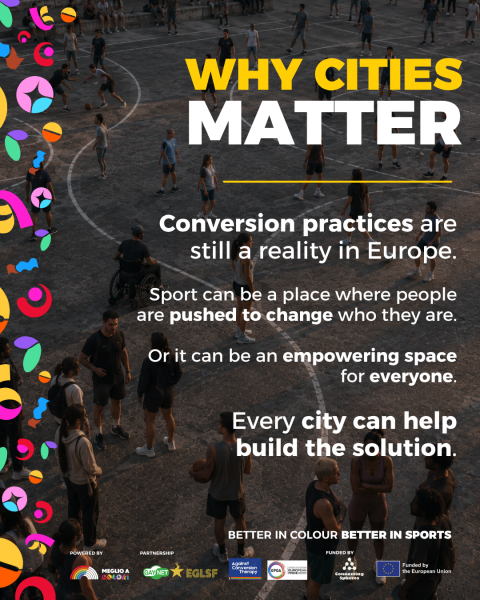
For EGLSF, these findings provide further evidence that sport has a crucial role to play in the fight against conversion practices and all forms of anti-LGBTQIA+ discrimination.
Conversion practices do not begin in therapy rooms alone. They emerge wherever people are told they must change to belong.
Inclusive sport offers a powerful alternative narrative: that everyone belongs exactly as they are.
As European institutions continue to discuss measures to prohibit conversion practices, this research highlights the importance of combining legal protections with community-based prevention, inclusive education, family support, affirmative healthcare, and safe sporting environments.
Because ending conversion practices is not only about banning harmful interventions. It is about building societies where nobody is ever made to believe they need fixing.
Download the Report
You can read the full report here. Stay updated on EGLSF channels as we keep promoting the results of the report and support the Play in Colour appeal, inviting municipalities across Europe to take a clear public stand against conversion practices targeting LGBTQIA+ people.
Leave A Comment