
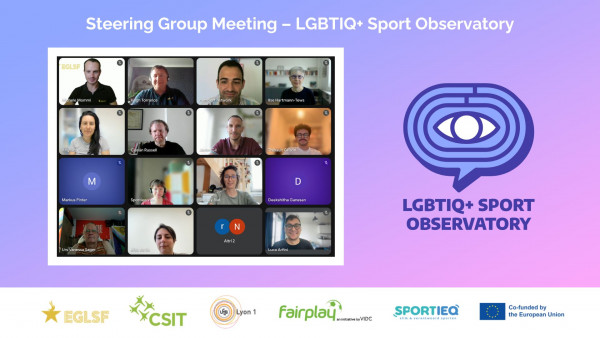
The LGBTIQ+ Sport Observatory project (EOLHSS) has officially launched its Steering Group activities with a first meeting on 18 June 2026, bringing together experts from academia, sport, and human rights organisations across Europe. The meeting was followed by an online coordination session involving all project partners.
This 36-month Erasmus+ Sport project, led by the European Gay and Lesbian Sport Federation (EGLSF), seeks to better understand, prevent, and address LGBTIQ+ hate speech in sport while exploring the development of a sustainable European observatory dedicated to the issue.
Bringing Together Expertise from Across Europe
The Steering Group includes representatives from leading organisations and institutions working in the fields of sport, research, and human rights. Participants included the University of Valencia (Spain), the University of Lille (France), the German Sport University Cologne (Germany), the European Region of the International Lesbian, Gay, Bisexual, Trans and Intersex Association (ILGA-Europe), Organisation Intersex International Europe (OII Europe), Transgender Europe (TGEU), and the Italian Association for Culture and Sport (AiCS).
The meeting enabled Steering Group members and project partners to become familiar with one another, review the project’s goals, and explore how the initiative can foster lasting change in European sport beyond the project’s timeline.
A Long-Term Vision for Inclusion in Sport
Opening the discussion, EGLSF Co-President Hugh Torrance presented the project within the context of EGLSF’s wider strategic priorities. These include strengthening the European LGBTIQ+ sports movement, expanding the impact of EuroGames, tackling exclusion and discrimination in sport, and strengthening engagement with European institutions.
The proposed observatory was presented as part of a broader effort to build long-term structures and knowledge that can support more inclusive sporting environments across Europe.
From Research to Practical Action
Michele Mommi, EGLSF European Projects Coordinator, introduced the project’s main activities and governance arrangements.
Over the next three years, the project will focus on gathering evidence, involving stakeholders, developing practical tools and resources, raising awareness, building capacity, and exploring sustainable long-term strategies to prevent and address LGBTIQ+ hate speech in sport.
The Steering Group will play an advisory role throughout the project, providing strategic guidance through regular online meetings and an in-person co-creation workshop focused on the observatory's future. The workshop is currently scheduled for 2028.
Learning from Existing Initiatives
Participants also discussed opportunities to learn from observatories and monitoring initiatives already operating at the national level.
Among the ideas explored were study visits and exchanges with organisations in Spain and other countries, creating opportunities to share experiences, identify good practices, and strengthen cooperation across Europe.
Addressing Hate Speech in a Digital Environment
A key topic of discussion was the challenge of responding to anti-LGBTIQ+ hate speech online.
Steering Group members highlighted the need to understand how digital hate speech affects sport and recognised that, while many responses are developed at national or European level, online hostility often spreads across international platforms and communities.
The discussion reflected a shared commitment to ensuring that the project remains relevant, evidence-based, and responsive to emerging challenges.
Looking Ahead
After the Steering Group meeting, project partners convened online to assess progress and plan future activities across the consortium.
Both meetings reaffirmed the partners and stakeholders’ commitment to creating safer, more inclusive sports environments and to evaluating the potential of a sustainable European Observatory on LGBTIQ+ Hate Speech in Sport to achieve this objective.
The LGBTIQ+ Sport Observatory project is co-funded by the Erasmus+ Programme of the European Union and coordinated by EGLSF in partnership with organisations from across Europe.

Funded by the European Union. Views and opinions expressed are however those of the author(s) only and do not necessarily reflect those of the European Union or the European Education and Culture Executive Agency (EACEA). Neither the European Union nor EACEA can be held responsible for them.
PROJECT NEWS
LGBTIQ+ Sport Observatory Steering Group Meets for the First Time
The LGBTIQ+ Sport Observatory project (EOLHSS) has officially launched its Steering Group activities with a first meeting on 18 June 2026, bringing together experts from academia, sport, and human rights organisations across Europe. The [...]
The LGBTIQ+ Sport Observatory Reveals its Visual Identity
The partners of the European Observatory on LGBTIQ+ Hate Speech in Sports (EOLHSS) have officially presented the project’s logo and visual identity during an online partnership meeting on 19 February 2026, marking an important [...]
PLUSS Final Meeting in Zagreb: Reflecting, Learning and Looking Ahead
From 16 to 18 January 2026, the partners of the Erasmus+ Sport project +PLUSS – LGBTQI+ Policy and Leadership in Sport and Society, led by the European Gay & Lesbian Sport Federation [...]
Leave A Comment